


|
|
21 Things You Can Do to Help
Get Brochures, Letters, Flyers, Door Hangers & Stuff to Distribute
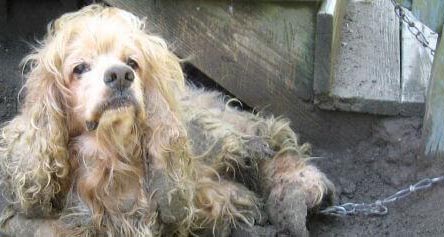
If you are reading this, then you are concerned about a chained-up or
neglected dog. Perhaps the dog is your own and you want to better his life. Perhaps the dog is one in your neighborhood whom you are worried about. There are many things you can do to help
end this form of animal cruelty!
- Bring your dog inside! Dogs get bored and lonely sitting on the
same patch of packed dirt day after day, month after month, year after year.
Dogs want to be inside the house with their "pack": their human family. Read
tips on housetraining and behavior modification to help your dog be a good “inside” dog.
Did you know that inside dogs make the best
guard dogs?
- Get to know the dog’s guardian if you are concerned about someone else’s chained dog.
See tips on talking to a stranger about helping their chained dog.
- Call your local animal control office, humane society, or sheriff’s department if
you see a dog who is:
- consistently without food, water or shelter
- sick or infested with parasites
- too skinny
A city/county official or humane society investigator is required to investigate the situation if the dog guardian is breaking your community’s animal cruelty law. In most communities, it is considered cruel to leave a dog without food, water or shelter; to not provide medical care to a sick dog; and to keep a dog undernourished. Even if your city doesn’t have an animal cruelty section in your city’s ordinance, your state will have a section in the state law that addresses animal cruelty.
Your state laws are online: do a keyword search for "Your State Code" or "Your
State Statutes."
Once you report the situation--don’t be afraid to follow up! Keep calling the authorities until the situation is resolved.
If animal control doesn't respond, write a letter describing the situation to
your mayor.
The dog is counting on you to be his voice.
More tips:
What
to Do When You Spot Animal Abuse
ASPCA's Top
Ten Ways to Prevent Animal Cruelty
- Offer to buy the chained dog from the owner. Just say something like,
"I saw your dog and have always wanted a red chow. Would you sell him to
me for $50?" You can then
place the dog
into a good home. Although some chained dogs are aggressive and difficult to
approach, many are very friendly and adoptable. Do NOT offer to buy the dog if you think that the
owner will just go right back out and get another dog.
- Put up a fence. Fences give dogs freedom and make it easier for
owners to approach their dogs, since they won't be excitedly lunging at the end
of a chain. Fences don’t have to be very expensive if you are willing to do some
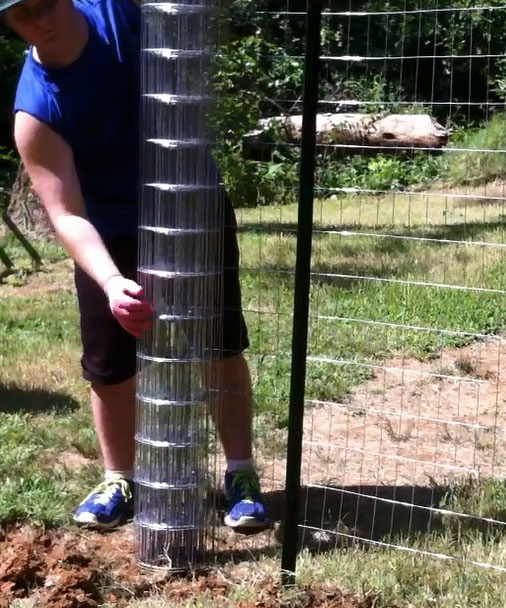
work yourself. You can attach mesh fencing to wooden
or metal posts for the cheapest fence. Chain link is easy to install, too. Visit
our Building Fences page for more information.
Workers at home-improvement, hardware and farm supply stores will
tell you exactly what materials to buy and give you advice on putting up all
types of fences. Check with fencing companies to see if they have leftover
materials for donation.
- Put up a trolley system if you can't put up a fence. A trolley
system is cheap and will give the dog much more freedom of movement than a
chain.
See pictures and an instruction sheet.
- If your dog can escape your fence, do one or more of the following:
- Install a 45-degree inward extension to the top of your existing fence.
Most home improvement stores can help you with this.
- If your dog can climb over a short fence,
extend
the height of the fence with mesh fencing. You can
also purchase inexpensive bamboo or reed fencing, which comes in 6-foot rolls.
Attach the bamboo fencing to the existing fence. It is difficult for a dog to
climb this slick fencing.
- Install an electric fence. At Petsmart and other pet supply
stores you can buy electric fence kits for both fenced and unfenced yards. Some electric fences attach to an existing fence. Other electric fences are buried underground.
- Install a "hot wire" to the top of your existing fence for
around $40-$50. Call a farm supply store for advice on putting up a hotwire. Hotwires are commonly used to contain cows and horses. They are a good deterrent to burglars, too!
- To stop diggers, bury chicken wire to a depth of one foot below where the
fence meets the ground (be sure to bend-in the sharp edges) or place concrete
blocks
around the bottom of the fence. You can also dig a trough under the fence
and fill it with concrete (along the full length of the fence or only in
"trouble spots").
- Purchase a 20 or 30 foot lightweight tie-out if a fence or trolley aren’t possible. Attach the tie-out to a strong stake that screws into the ground. Place the stake in a central location so that the dog can move around all sides of the stake. You can order these materials from
PetsMart.
Note: We have found that the
Duckbill
Anchor kit is a very strong stake. Using a stake and long tie-out is only a
last resort to help a dog who is chained to a short chain. A fence is always the
best option and allows the dog the most freedom.
- Spaying and neutering a dog will help him to calm down and stay closer to home. A sterilized dog won’t try to escape to find a mate!
Sterilization is healthy for your dog: it reduces his or her risk of contracting
certain types of cancer. Sterilization won't change your dog's personality.
Sterilized dogs can still make great
guard dogs and
hunting dogs.
Investigate low-cost spay/neuter programs in your area.
(Little Rock residents contact
CARE.) Call
SpayUSA at 1-800-248-SPAY to get a coupon. If you are trying to help someone else’s dog, ask your own vet and ask if s/he will give you a discount as a community service.
- Replace ill-fitting, old collars with a new nylon collar. You should be able
to easily fit two fingers between the dog's neck and the collar. If you need
to add a hole to a collar, hammer a thick nail through it, or (carefully!)
heat a pick and poke it through.
- Provide food and fresh water EVERY day. Every day that you eat,
your
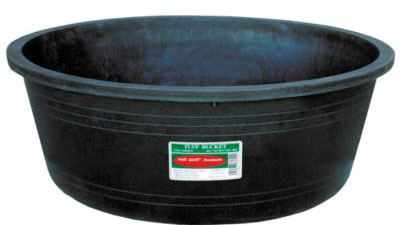
dog needs to eat, too. You can place a water bowl inside a tire
or in a hole in the ground to keep it from tipping. You can also attach a water bucket to a wooden doghouse or fence. Stretch wire, a small chain, bungee cord, or twine across the
bucket and secure the wire on either side of the bucket.
- Provide proper shelter for the dog. Dog igloos can be purchased
pretty cheaply from discount stores, farm supply stores, and hardware stores.
If you can’t afford to buy a doghouse, you can
make one.

- Doghouses should be large enough for the dog to stand up and turn around
comfortably, but small enough to retain the dog's body heat.
- Wooden doghouses
should be raised a few inches off of the ground to prevent rotting and keep out
rain. Flat concrete blocks are an easy way to raise a doghouse.
- Dogs enjoy
having towels and blankets to curl up on. Remember to wash them every few weeks
so they don't get stiff with dirt.
- Give your dog toys and rawhides.
Dogs need the stimulation provided
by toys, just like kids do. A big rawhide will occupy a dog for
several hours (dog toys and rawhides are available at grocery stores). Even a knotted towel or ball can provide hours of entertainment.
Toss toys over the fence if the dog belongs to someone else.
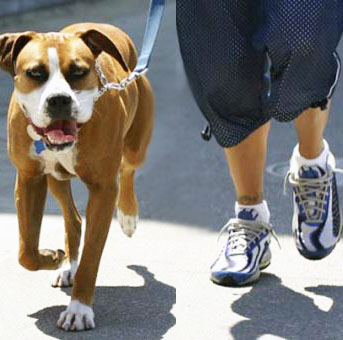
- Take your dog on walks! It will mean the world to your dog to be
able to get of the yard, see new things, and smell new smells. Walking your dog
is great exercise for both you and your dog.
If the dog is very strong or large, you can use a prong collar or harness to
make walking easier on you. Ask pet store workers to help you get the dog fitted
for a collar or harness.
If the dog belongs to someone else, offer to walk
the dog yourself.
- Take your dog to school! Obedience training can solve behavior
problems and help the dog learn how to be a good “inside” dog. Most pet stores offer inexpensive dog training.
- Provide your dog with flea treatment, heartworm preventative, and annual
worming. Read a fact sheet on parasites and how
to treat them. Most farm supply stores sell wormers and vaccinations at much,
much cheaper prices than vets.
-
Protect your dog from winter cold.
Dogs get cold in the
winter just like we do, especially short-haired and small dogs. Dogs can even
get hypothermia and frostbite. If it is too
cold for you to sleep outside, your dog is going to be cold outside, too.
- If you can’t bring the dog inside in icy winter, fill doghouses with hay or cedar chips
to help your dog retain body heat. (Cedar chips are preferable because
they are less likely to rot and don't contain mites.) You can get cedar shavings
and hay at farm supply, hardware, discount, and home improvement stories. If you
use hay and it gets wet and soggy, spread it in the sun on a sunny day to dry it
out.
- To keep cold air from blowing through the doghouse, the door should be covered with a plastic flap.
You can use a car mat, a piece of plastic carpet runner, or even a piece of
carpet.
- Dogs need more food in winter, as keeping warm consumes calories. Check your
dog's water bowl daily to be sure it isn't frozen.
- Provide shade in the summer. Sitting in the hot sun all day is miserable
for a dog. Bring your dog inside during heat waves if
possible. Plant trees to provide shade. You can also create shade with tarps and
pieces of plywood.
- Fill up a plastic kiddie pool for hot summer months. Dogs enjoy
cooling off in a pool as much as we do. What a cheap way to ease those hot
summer days for a dog!
- Change the law in your community to
ban
chaining!
- Educate people about chaining! Keep some
educational brochures and flyers in your car. If you see a chained dog, you can
put a brochure in that person’s mailbox.
(NOTE: You will need Adobe Acrobat Reader to view the following PDF files. You can
download
this software free.)
- This
document is
for the owners of chained dogs. It is a compilation of information from this
website, including 16 Ways to Improve Your Dog's Life, Behavior and
Housetraining, Fence Building, Building a Trolley, Guard Dog info, and more.
- Download and distribute "A
Chained Dog's Plea" and two other poems. Sometimes these poems can be more
effective than a factual brochure.
- Download a
Q & A
sheet geared toward passing a law.
- Download a sheet of
photos of chained dogs and children who have been attacked and injured.
- Encourage educators in your community, from scout leaders to teachers, to
teach children why chaining is cruel.
- Visit Dogs Deserve
Better
to download informational flyers, letters,
posters,
door hangers, and brochures
for distribution.
Spanish
letters and
Spanish flyers are available.

- Merchandise
with the DDB logo is also a great tool
for education.
- DDB's new brochure is excellent--you can view and
order it here.
- Join DDB's
E-Newsletter to get updates on efforts to help chained dogs. Enter your
email address in the yellow box in the right column of their
homepage.
- Dogs Deserve Better also has an educational
video/DVD
called
I Am Unseen for only
$8.00. A great tool for showing in schools and at meetings!
- Check with your local TV stations to see if they will air one of the
following free PSAs. Just ask for the Community Affairs person or whoever is in
charge of PSAs. The station will probably want it in BETA--and PETA does provide
the PSAs in BETA format. Click
here to have a
PSA sent to your television station.
PETA offers excellent 30-second Public Service Announcements for TV:
Ricki Lake
Backyard Dogs
Michael Strahan Cold Dog
Chilly Dog
Justin Theroux
Chained Dog
Loretta Lynn
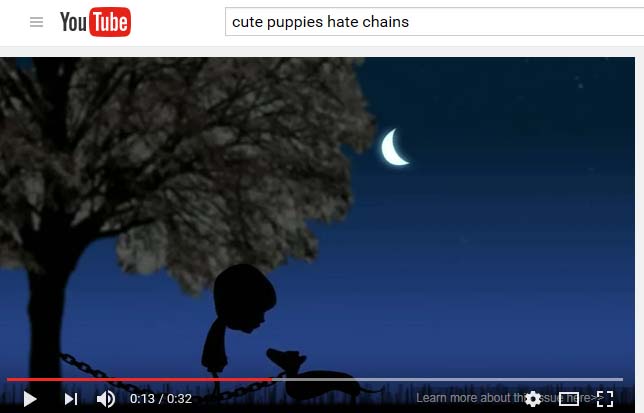
"Wanna Be Free" cartoon PSA
View
all PSAs.
ASPCA offers a great
PSA featuring hip-hop mogul Russell Simmons encouraging people to report animal
cruelty and be kind to animals. A great way to reach out to urban youth.
- Click the the picture at the right for more information on PETA's
Unchain A
Dog campaign.
- Humane Society of the United States also has a
campaign to help chained dogs.
|
 |

- Call the Humane Society of the United States at (202) 452-1100 to order 50 copies of the brochure
Do You Chain Your Dog? for $1.
- Little Rock residents can distribute this
brochure.
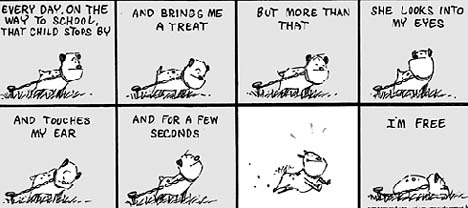
Guard Dog,
from Mutts comic strip. Used with permission.
[Back to top]
|