

 |
|
|
||||||||



Caring for Your Dog
|
|||
| Teaching your dog to be a well behaved family member will take time, but will be worth it as your dog becomes a loved friend. Dogs who have been chained can make great house dogs, but will need extra training. Your "outside" dog will be excited when first coming in. Don’t give up! It will take some time for your dog to calm down and become an indoor family member. |
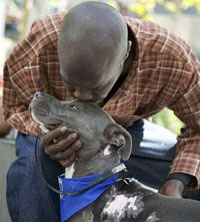
Behavior Tips
- Aggression: Read this great ASPCA article.
- Barking: Chained dogs bark out of frustration and loneliness. Just getting your dog off the chain will reduce barking! Try teaching the word "quiet." When your dog barks, after two or three woofs, praise her for sounding the alarm. Then say "quiet" and give a treat. Most dogs stop barking because they can't eat and bark. During this quiet time praise her, "Good girl, quiet." Each time she is told "quiet" and succeeds, give a treat. Cesar's article | ASCPA article
- Baths:
You will enjoy spending time with your dog more if
she's nice and clean! The easiest way to bathe
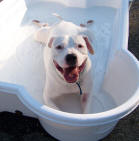 a dog outside is to tie
her to a deck, fence, etc. so she can't escape. You can loop a leash
through or around the deck rail, etc. I love the
Rapid Bath system which fits to your hose so the soap and water come
out together. Whenever you bathe your dog, throw the collar in the wash
to keep it soft and clean.
a dog outside is to tie
her to a deck, fence, etc. so she can't escape. You can loop a leash
through or around the deck rail, etc. I love the
Rapid Bath system which fits to your hose so the soap and water come
out together. Whenever you bathe your dog, throw the collar in the wash
to keep it soft and clean. - Begging: Decide no one will feed the dog from the table. Don't allow guests to break this rule. Feed him before your meal. If he never gets to eat from the table, he won't try!
- Chewing/Mouthing: Dogs need to get used to the feel of human
skin, but also need to learn how to be gentle. When the dog nips on you,
yank back and say, "Ouch". Not the way a person would say it, but the
way a puppy would say it...high-pitched and loud! She will think she's
hurting you. If this escalates the mouthing, pull your hand away
and turn away from your dog for 5 seconds. Do this every time
she chews. She will learn that she gets ignored for chewing on you.
Replace whatever she was chewing on with a rawhide or toy and praise her for playing with the toy. A spritz in the face with a water spray bottle will help deter mouthing. ASPCA article. - Destroying Things: Never leave your new dog alone in the
house. You are asking for trouble if you let an untrained dog have
full run of the house! A crate is best. Privileges are earned and your
new dog must be trained before having total freedom.
Keep plenty of chew toys and rawhides handy. A spray bottle with water is a great way to stop bad behavior. When he starts to chew on the furniture or act inappropriately, spritz him in the face with water. Anti-chew spray like Bitter Apple tastes terrible and deters chewing. ASPCA article - Digging: If your dog is digging from boredom, walks and coming inside will redirect his energy. If digging to escape, bury chicken wire along the base of the fence. Dedicated diggers may need a "digging zone" with loose soil or sand. Bury treats there to encourage digging in that area. Read article.
- Jumping:
When your dog jumps on you, quickly bring your knee
up and
turn away. Don’t say anything or look her in the eye. Your dog wants your attention
and will take negative attention as well as positive. Only give your dog attention
when all four feet are on the floor, or preferably when she is
sitting.
Leaving and returning should be low-key. If you come home and greet your dog loudly, excited, and full of energy, your dog will be excited, too. Stay calm and encourage calm behavior before giving out treats and attention. - Leash Training: Start with short
walks and be patient!
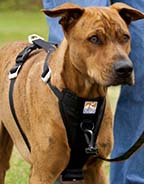
For large strong dogs, an
"easy walk",
harness that hooks in front
or
leash that hooks around your waist is a great solution. Prong and vibrating collars may be good tools,
too. Pet stores can fit your dog for harnesses and help.
Try tiring the dog out before walking – throw a ball or play chase. This will get some of his energy out.
 The
goal is for your dog to walk beside you with a loose leash and be focused on you. If you
let him pull to the end of the leash, you will create a pulling machine!
Get a short non-retractable leash and bring training treats (or hot
dog cut into small bites) in a baggie or
treat pouch.
The
goal is for your dog to walk beside you with a loose leash and be focused on you. If you
let him pull to the end of the leash, you will create a pulling machine!
Get a short non-retractable leash and bring training treats (or hot
dog cut into small bites) in a baggie or
treat pouch.
Each time he pulls forward, stop and pull him back with the word "heel". When he walks beside you, offer a treat and praise. You can stop during your walk and have him "sit" for a treat to encourage being by your side. Only move forward when he's not pulling. Bring a water bottle and spray in his face to stop pulling toward other people/dogs. Read article.
- Introducing Two Dogs: Leave your current dog home when
getting the new dog. Introduce them on neutral territory, such as on the sidewalk, then take them on a walk to get used to each
other. Next, let them in the yard together on leashes, then let them run
around the yard. Next, go to a large room in the house where they can
keep some distance. Feed them separately for a few days and don't leave
treats or toys out they can fight over. Don't leave them in the same
room alone until you are confident they are getting along.
Dogs will have to work out between them which is alpha or "the boss", so some growling and posturing is natural. Keep that water spray bottle handy and spritz in their faces if they get overly aggressive, then praise when they act nicely! Read article. - Separation Anxiety - Read this detailed ASPCA article
- Sitting: Simply hold a treat in front of her nose, then above her head until she sits back to follow the treat in your hand. Repeat the word sit several times, then immediately give praise and the treat. Most dogs quickly learn the combination of the word "sit" and a hand motion above their head. Read article.
| [top] |
Housetraining Tips
The Golden Rule of Housetraining is...
Never let an un-housetrained dog out of your sight while inside!
Every time a dog relieves himself inside, it teaches him it’s
OK. An un-housetrained dog should be either:
(1) Inside, with you watching him
(2) Outside
(3) In a crate
If you follow these rules, your dog should be trained in a week or two. Adult dogs can be housetrained, too!
- The best method is the crate training method. Buy a pet carrier
or cage big enough for your dog to stand up, turn around, and lie
down in. This will be the dog's “den” and sleeping place.
Dogs are clean animals and want to keep their home and sleeping area clean. Even young puppies will try their best not to go inside their crate. - On the dog’s first day home, let him wander in and out of the crate. Put a towel and some treats in it. Put the crate close to where the family hangs out, so your dog will feel like part of the family.
- Young puppies must go out many times a day, 30 minutes after eating or drinking. Older dogs need to go out four or more times daily.
- Take the dog to the SAME spot outdoors. The smell will remind him why he's there.
- When puppy relieves himself outside, PRAISE him, "Good Dog!!” and give him a treat. Praise is the key to housetraining! Your dog will learn that going outside means treats and will be eager to go out.
- If you're inside and notice your dog starting to sniff and circle, grab him and take him out. If you catch him in “mid-stream”, startle pup with a noise and take him out.
- What if you notice a mess on the floor but didn’t see your dog do it? Clean up the mess without fussing at your dog. Dogs live in the moment and won’t understand that you are punishing him for something he did in the past. Rubbing your dogs’ nose in the mess or hitting him with a newspaper won’t work.
- Use a cleaner that will kill smells and bacteria, such as Simple Green (grocery stores), Nature’s Miracle (pet stores), or vinegar and water. If you don’t clean the spot very well, the smell might make him go there again.
- At bedtime, take your dog outside and then lock him in his crate for the night. He'll make an effort not to foul his bed. Then take him outside first thing in the morning. Some young puppies may not have the muscle control to hold it all night and will have to go out during the night.
- Don’t feed your dog after about 6:00 p.m. This will help your dog make it through the night.
- Dogs can be left in a crate 4-6 hours. Dogs should not be left in a crate more than 8 hours. If you can’t come home during the day, consider leaving the dog outside.
- Tips: Hang a jingle bell on the door and jingle it when you take
your dog out. He will learn to ring the bell when he needs to go
out.
Install a dog door. Dog doors are a wonderful invention! Dogs quickly learn to come and go on their own.
Read a schedule of a typical day of crate training.
More articles and advice on housetraining, including hard-to-manage cases.
| [top] |
Household Hazards
- Anti-freeze (dogs love it but it is deadly)
- Blind cords (wrap or tuck them up high)
- Chocolate
- Cleaning products
- Electrical cords and cables (Tape to the floor or cover with plastic tubes made for this purpose)
- Fertilizer
- Human medicine
- Insecticides - ant killer, roach bait, rat poison
- Paint
- Paperclips
- Plants - Some can be poisonous, including tulip/daffodil bulbs, amaryllis, poinsettia, lilies, sago palm
- Pins and needles
- String and ribbon
- Twist ties
Ensure no small pets are in your dryer before turning it on!